During
the 2nd and 3rd centuries Greek sage and Jewish scribe,
pagan hierophant and Egyptian
priest, all contributed to the fabulous legend of Jesus.
The common promise was an afterlife, no longer just
for
the elite
but for all and sundry. In
the early 4th century, the worship of Christ became
a State sponsored cult
throughout the Roman Empire – and was particularly
successful in Egypt.Thereafter the iconography of the godman emerged from earlier art forms but reflected the dictates of governing elites.
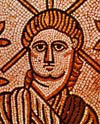
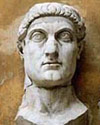
Within 50 years of Constantine, Christ
gets an identical face!
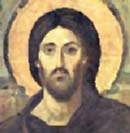
JESUS
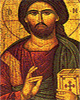
4th century mosaic, one of the earliest known depictions of Christ.
CONSTANTINE
4th century head of Emperor Constantine
Don't
I know that face...?
Those big, staring eyes,
that dimpled chin.
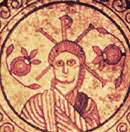
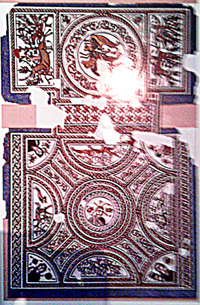
The 4th century mosaic floor from a villa at Hinton St. Mary, Dorset, England, now in British Museum.
The mosaic covered two rooms, with the smaller area depicting Bellerophon killing the Chimera. The larger room was possibly for dining, meaning guests not only walked on their Christian god, but also ate above him!
In truth, the villa's owner almost certainly chose designs that pleased him, both traditional pagan motifs and Christian fashions popularised by the imperial court.
Note that the Christ image faces away from the entrance porch – and is flanked by the pomegranates of Persephone!
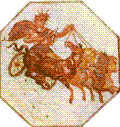
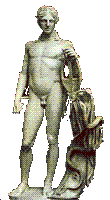
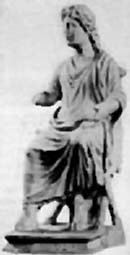
Apollo (aka Helios, Phoebus),
sun-god on his daily ride across the sky.
Like Horus before him
and Christ after him, he was the Light of the World.
Apollo was also the god
of healing, so sick people prayed to him.
He was also, son of the
Big Guy – who in those days went by the name of Zeus!
Looks familiar...
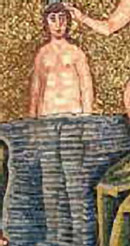
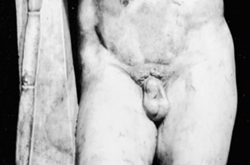
Young, Antinous-like Christ (complete with exposed genitals) gets
his holy bath
6th century Arian baptistery, Ravenna
Aging
God
"The
figure of Christ,
which had at first been youthful, becomes older from century
to century... as the age of Christianity itself progresses."
– Adolphe Didron, Christian
Iconography.
Lamb Chopped
At the close of
the 8th century, Pope Hadrian I (772-795) confirmed the decrees
of the 6th Synod of Constantinople held almost a century
earlier and commanded that thereafter "the figure of a man
should take the
place of
a lamb
on the cross."
It took Christianity
eight centuries to develop the ubiquitous symbol of its suffering
Savior.
For 800
years, its Christ on the cross had been a lamb.
But if a real flesh
and blood Jesus had actually been crucified,
why was his place on the cross so long usurped by a lamb?
Well Dead
Michelangelo Gets with the Program
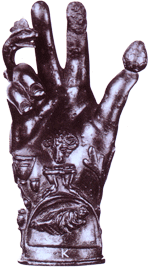
Giving the finger
The hand of benediction from the god Sabazios – the Phrygian
"Zeus" (6th century BC).
Worship of the god merged into the cult of
Dionysus during the Hellenic period.
The ornate votive offering is covered in mystical symbols.
Early Christians were so taken by the awesome magic
of finger gestures that they expropriated the trick for them-selves.
It masquerades today as the "sign of the cross" or Holy Trinity.
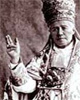
Pope Pius X gives the finger – as does JC himself!
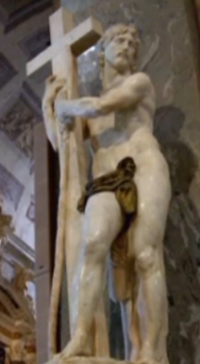
Michelangelo's Christ
– Loses Penis!
– but gains a girdle!
Basilica di Santa Maria sopra Minerva, Rome.
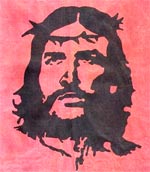
'Che Jesus'.
The Lord can be anything you want him to be.
Essays
If you are looking for the best place with a team of professional academic writers check
Handsome,
young, healthy and naked. (Hmm,
that won't do for a Christian empire... )
A messianic
savior god, promising personal salvation was the
ultimate product of syncretismin the lands of the eastern
Mediterranean.
This God was a synthetic,
composite character, combining the characteristics of Serapis (a king
and judge), with Greek sage, a compassionate teacher of wisdom, a perfect
man (Antinous) and the Roman variant of the sun-god – Mithras.
The
winning ingredient of the Christians was to bring this
new god to life by setting him in a Jewish
pageant, clobbered
together from plagiarized episodes of Old Testament scripture and well-worn pagan motifs from the mysteriy cults. To Emperor Constantine the
superstition was useful.
The
various 'biographies' (gospels) were never fully harmonized;
it took over three centuries of violence to
more or less agree the underpinning 'theology' but then – WHAT
A SUCCESS STORY!
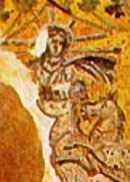
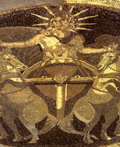
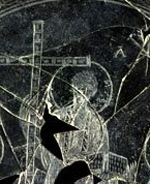
JC takes
over from Apollo as the Sun God in his fiery chariot
3rd century,
tomb mosaic, Rome
Apollo - 2nd century AD
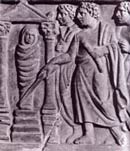
JC, with augur's wand and legislator's scroll, raises Lazarus
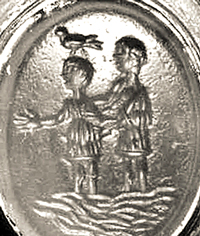
Long before the fable of Jesus the dove symbolised the sacred feminine (Astarte, Tanit, et al). By the 1st century the goddess had been marginalised and now the dove stood for the "spirit of God."
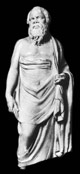
JC dons
his philosopher's toga
4th century,
Rome
Socrates – 5th
century BC Athens
JC with short hair and beardless on engraved glass plate.
4th century,
Linares (ancient Castulo), Spain
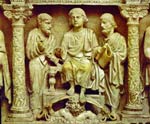
Constantine again?
Notice that Jesus has his foot on the head of a fallen pagan god.
Propaganda in stone in the battle with the old gods!
JC takes
over as teacher
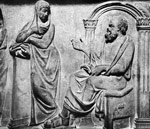
4th century – Sarcophagus
of Junius Bassus (Rome, 359 AD)
Greek philosopher
as teacher.
Socrates – 5th century BC Athens.
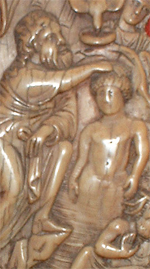
Baptism of boyish 6th century Christ (Ivory,
Egypt or Syria – British Museum)
.
Note: The River
Jordan is personified (lower right).
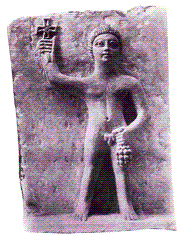
4th
century Antinous, with Cross in one hand – and
the grapes of Dionysus in the other!
(Stele
from Antinoopolis, Egypt.
Staatliche Museen, Berlin)
JC
takes inspiration from a human sacrifice (Antinous)
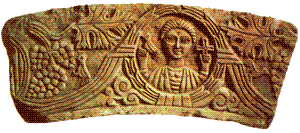
6th/7th century
Coptic Christ, Egypt
– note the grapes of Dionysus!
Clothed – but
is that a family resemblance to Antinous ?!
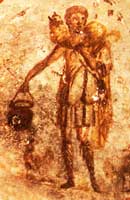
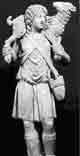
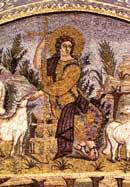
JC,
as Good Shepherd, wields his cross as a shepherd's crook
5th century mosaic,
tomb of Galla Placidia, Ravenna
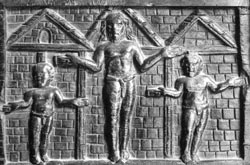
A relaxed, well-fed JC stands, rather than hangs, from his cross.
5th century carved wooden panel, door of Santa Sabina, Rome.
Note that Jesus and the thieves stand in the orans pose, arms outstretched with palms up, a pose associated with prayer – and paganism.
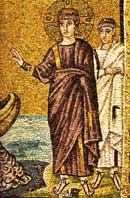
JC,
clean shaven young man, as Greek philosopher, moving
in polite society, sporting Apollo's sun
'nimbus'
6th century mosaic
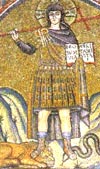
JC as
soldier – this time carrying his cross like
a lance, strutting about as a Roman conqueror
6th century
mosaic, Archiepiscopal Chapel, Ravenna
JC changes
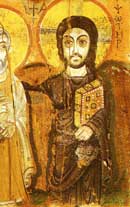
philosopher's toga for monk's habit, grows a rabbi's
beard, gets older.
6th century,
Mt Sinai Monastery
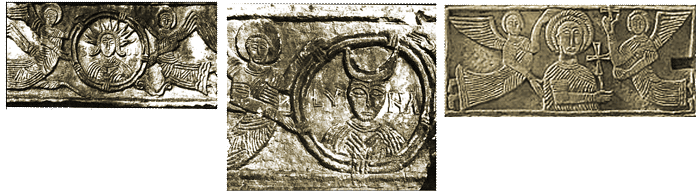
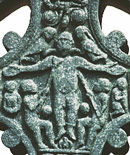
JC joins a frieze of Sun and Moon gods, held aloft by angels. One of the family?
6th-7th century,
Church of Quintanilla de las Viñas (Burgos), Visigothic Spain.
JC,
older and weary but not yet hung on a cross.
6th-7th century,
Egypt (Coptic, Louvre)
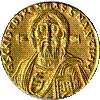
Gold solidus issued in 692 by Byzantine Emperor Justinian II bears the image of a monkish Christ.
7th century,
Byzantium
In the West
JC,
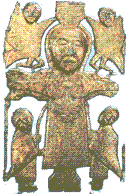
beardless but now with distorted proportions, gets nailed
to his cross.
7th century, Athlone, Ireland
JC
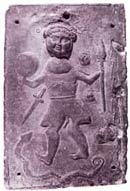
becomes a Frankish warrior, complete with Woden's headdress,
weapons and long penis!
7th century,
France
JC loses his humanity, becomes solemn, stylised
icon.
7th-8th century,
catacombs, Rome
JC,
hung up to die (but keeps his clothes on)
9th century, Chludoff
Psalter
JC,
bearded yet still young, is the Christus Triumphans – on
his cross but alive and without suffering.
10th century,
Ireland (Monastery of Monasterboice)
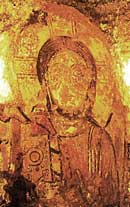
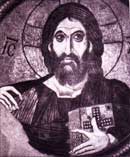
JC – older,
uglier – just like the Church
11th century,
Sinai Monastery ("Pantocrator") Daphni, Greece
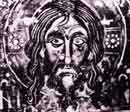
JC – mean,
sinister – just like the Church
12th
century, Russia (fresco)
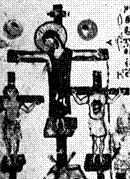
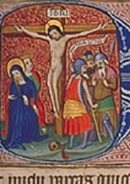
JC
naked and limp on his cross
15th century manuscript
(Aberdeen)
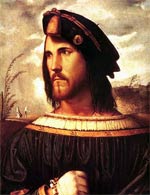
Jesus becomes a Borgia!
1520
Altobello
Melone paints Jesus on The Walk
to Emmaus.
1520
Altobello Melone paints Cesare Borgia,
son of Pope Alexander VI and thoroughly nasty piece of
work.
The familiar image of Jesus Christ – modelled
on the notorious Renaissance prince, in turns archbishop, cardinal, warlord and
murderer. Dead at 31. At one point Cesare hired the services
of Leonardo da Vinci (see Shroud).
JC
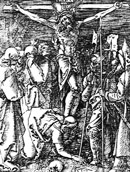
in agony – Just
like Christian Europe
16th
woodcut (Durer)
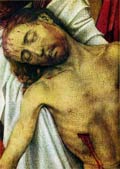
JC
emaciated, dead
16th century,
Netherlands (David Gerard)
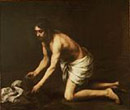
JC – On
his knees, beaten, suffering – looks promising ...
17th century, Spain
That's
better – a tortured man for a tortured society ...
Christianity
triumphs
Sources: William Dalrymple, From
the Holy Mountain (Flamingo. 1998) Michael Walsh, A Dictionary of Devotions (Burns & Oates, 1993)
Ian Wilson, Holy Faces, Secret Places (Doubleday, 1991)
Dom Robert Le Gall, Symbols of Catholicism (Editions Assouline, 1997)
Webb & Bower, The Illustrated Gospel of St John (1985)
Robin Keeley, Jesus 2000 (Lion, 1989)
R. E. Witt, Isis in the Ancient World (John Hopkins UP, 1971)
Keith Hopkins, A World Full of Gods (Free Press, 1999)
Timothy Ware, The Orthodox Church (Penguin, 1993)
Some fifty articles are now available as a book.
For your copy order:
Do you really
think it all began with a sanctimonious Jewish
wonder-worker, strolling about 1st century Palestine?
Prepare to be enlightened. Jesus –The
Imaginary Friend
Much
of the mythology of Christianity is a rehash of
an older and even more transparent fabrication – Judaism. Jew
Story – The Way
of the Rabbi
Human
ingenuity and cunning is matched by mankind's equally
monumental credulity and wishful thinking. Christianity's Fabrication
Factory
Church
organisation, authority and membership preceded
rather than followed the justifying doctrine. As
the organisation and its needs changed so has the ‘Testament
of God’ adapted accordingly. Dogma – The
Word in all its Savage Glory
From
religious policeman to grandee of the church,
from beast fighter in Ephesus to beheading in
Rome, Paul's story has more holes than a swiss
cheese. St
Paul the Apostle – Dead
in the water?
Raised
to the status of State religion the Christian Church
reigned over the destruction of civilization. As
the centuries passed religious barbarism grew ever
more vicious. Winter
of the World – The
Terrible Cost of "Christendom"
For two millennia
Christianity's anti-sexual, puritanical doctrines
have inflicted untold damage on the mental, emotional
and physical lives of countless millions of people. Those SEXUALLY
hung-up Christians – Loved-up
for Jesus