Bull
Slayer
Eclipsed as it
was in later centuries by the faith of Christ, Mithraism or
rather, its Romanised form Sol Invictus was
the first universal religion of the Greco-Roman world.
Mithraism
anticipated Christianity in all major respects bar one, and
enjoyed a reign of at least five centuries. It peaked
around the year 300 AD when it became the official religion of
the empire. At that time, in every town and city, in every military
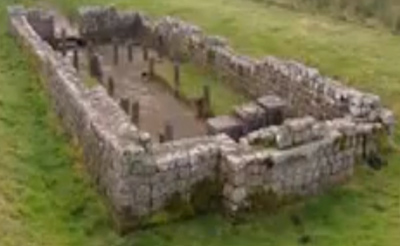
garrison and outpost from Syria to the Scottish frontier, was
to be found a Mithraeum and officiating priests of the cult.
Mithraism was
the religion of choice of fishermen, merchants, and
in particular, the military who adopted Mithras rather like latter-day
soldiers would adopt St. Michael or St. George Mithras
slew bulls, St George slew dragons! Mithraism waged and
lost a two-hundred year battle with the upstart religion
of Christ, into which much of its ritual, and many of its practitioners,
were subsumed.
Fatally, Mithraism
had excluded women entirely, causing well-heeled Roman matrons
with a pious frame of mind to explore first Judaism, and then Christianity.
Also, unlike Christianity, it made no special overtures towards
the uneducated, downtrodden and marginal elements of society. It
was a religion chosen by emperors, not slaves.
Mithras
Goes to Rome
The cult of Mithras
was actually of very ancient lineage, traceable in one form or
another through at least two thousand years. In origin it was the
primordial sun-worship the father of all religion. Iconography
showed Mithras, in Phrygian cap and cloak, riding his fiery chariot
across the sky. But it was also an eastern religion, reaching
the Roman world from India via Persia. Traditional hostility with
Persia did not favour Rome adopting a religion of its enemies.
This changed however in the 60s BC when Pompeys legions first
entered Syria. Mithraism had so well established itself in the
Commagene, Armenia and eastern Anatolia that whole dynasties of
kings had called themselves Mithradates (justice
of Mithra).
Romes troops
took to the machismo faith, with its ceremonies of
male-bonding and triumph over death, of self-control and resistance
to sensuality. Acolytes were required to descend into a pit, which
was then covered by boards filled with holes, and the blood of
a sacrificial bull above would shower onto them. Thus sanctified
they could re-emerge from the pit reborn in Mithras.
This sacrament, the taurobolia, was the Mithraic forerunner
of the Christian baptism. Mithras rock tomb (and place
of re-birth) the petra was central to
each Mithraeum. The rock connection was later re-worked
into the legend of Saint Peter.
Legionaries took
the cult with them into Palestine and back to Rome itself. Several
hundred Mithraic monuments have been found in Rome (Coarelli, 1979).
Adapted for Roman taste, the most popular Romanised form of Mithraism
was Sol Invictus, the Unconquerable Sun, whose re-birth
was celebrated as the climax of the mid-winter Saturnalia, on 25th
December (Celsus tells us that in the Mithraic mysteries the soul
moved through seven heavenly spheres, beginning with the leaden
Saturn and ending with the golden Sun).
 |
Mithras
(right) with his friend 'Sol'.
Looks a little familiar
..?
(Dura-Europus) |
|
|
Egypt – raised hands for sun-worship. |
|
 |
Ahura-Mazda/
Mithras
On
his tomb at Nimrud Dag king Antiochus
I of Commagene (northern Syria/eastern Turkey) greets
a god from Persia .
(1st century BC) |
|
Precursor
of Christianity
The theology
of Mithraism was centred upon the dying/rising Mithra, emerging
fully grown from the virgin dawn or rock. The association
of gods with rocks or stones is not surprising: fiery rocks falling
from the sky (meteorites) and even sparks released by colliding
stones would equally strike the simple mind as evidence of
a godly presence. Holy stones were anointed with oil. Mithra was
fathered by the creator god Ahura-Mazda.
Miracle
Birth

Roman
silver token/coin showing birth of Mithras. He
emerges fully formed from a rock.
On
reverse Mithras is linked with creator god Ormzad
and Egyptian sun god Re.
(Verulamium,
England, 2nd-3rd century) |
|
Mithrass
supposed creation had occurred in a time before men,
a cosmic creation
in a celestial heaven. At no time was it believed that he had lived
as a mere mortal and trod the earth. Mithraism's
failure to have anthropomorphised its god into a man something
which was to be accomplished so successfully by Christianity weakened
the cult's appeal to the uneducated and opened the door to the
competition.
In all
other major respects the theology of the two cults were all
but identical.
Mithras had had twelve
followers with whom he had shared a last sacramental meal.
The evidence from a mithraeum at Dura Europus suggests members of the congregation and thiasos (sacred company) held a banquet in which eating, drinking and musical performances featured as well as religious ceremonial.
"A third-century account for the mithraeum at Dura Europus lists the prices of materials required for a ritual banquet:
'Meat, 19 denarii; sauce, 1 denarius; paper, 1 obol; water, 1 denarius; wood, 1 denarius; jar of wine, 28 denarii 11 obols; total 51 denarii 11 obols.' "
– K. Butcher, Roman Syria, p213.
He had sacrificed himself to redeem mankind. Descending
into the underworld, he had conquered death and had risen
to life again on the third day. The holy day for this sun
god was, of course, Sunday (Christians continued to follow the
Jewish Sabbath until the fourth century). His many titles included the
Truth, the Light, and the Good Shepherd. For
those who worshipped him, invoking the name of Mithras healed
the sick and worked miracles. Mithras could dispense
mercy and grant immortality; to his devotees he offered hope.
By drinking his blood and eating his flesh (by proxy, from a
slain bull) they too could conquer death. On a Day of Judgement
those already dead would be raised back to life.
Popular
Motifs
All this may
surprise modern Christians but it was very familiar to the Church
Fathers [See e.g. Justin, Origen, Tertullian], who filled their Apologies with
dubious rationales as to how Mithraism had anticipated the whole
nine yards of Christianity centuries before the supposed arrival
of Jesus diabolic mimicry by a prescient Satan being
the standard explanation. Pagan critics were not slow to point
to the truth: Christianity had simply copied the popular motifs
of a competitive faith.
Mithras was
proclaimed the principal patron of the empire by Aurelian in 274
AD (on December 25th he dedicated a temple to the sun-god in the
Campus Martius). Mithraism was adopted by Diocletian in 307 AD
and by Julian as late as 362 AD. The cult was driven from the scene
over the next hundred years by furious and sustained attacks from
Christianity.
Who would
defend Mithras?
Mithraism lacked a professional clergy;
it had no hierarchical organisation disciplined by common rules.
Though popular throughout the empire, the cult's ceremonials
had remained heavily dependent upon state patronage and support.
When state funding was transferred to the Church by Constantine
and his successors, Mithraism's fate was sealed.
Fatally, during
the reign of Emperor Gratian (367-383 AD), its sanctuaries were
sacked of their wealth and closed. Thirty years later, Theodosius
made worship of Mithras punishable by death. The god had fallen but
the imagery and iconography of Mithras were expropriated wholesale
by the more comprehensive and favoured cult of Christ. Onto Jesuss
head fell Mithrass sun disc. Christian bishops assumed his
headdress and mitre.
Today the
Vatican stands where the last sacrament of the Phrygian taurobolium
was celebrated.
( S. Angus, The Mystery Religions, p235)
 |
The Magi attend the birth of Jesus. Their "Adoration"
symbolizes the submission of Mithraism to triumphant
Christianity.
(From 6th century Thessaly, British Museum) |
|
Faint echoes
of the fallen god were to be heard in later Manichaeism.
In the 4th century,
ordinary Christians had not yet acquired the abject humility and
submissive behaviour that would characterise the brethren of later
centuries. In church, they sang, danced and clapped.
And when
they prayed it was facing to the East, with hands held wide and
with face held up, not down to greet their sun-god!!
Early
Christians pray to their god – the Sun! |
 |
Christian
Sarcophagus
3rd century, Rome. |
|
 |
Christian
chapel
Roman villa , Lullingstone, Kent 4th century. |
|
"I will therefore that men pray every where, lifting up holy
hands, without wrath
and doubting."
– St Paul (1 Timothy 2,8)
Copyright © 2004
by Kenneth Humphreys.
Copying is freely permitted, provided credit is given to the author and
no material herein is sold for profit.
|