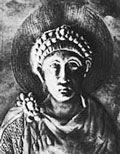
A triumphant Christian Church, far from unifying the Roman world
with a single faith, rent division and civil conflict throughout
the empire. Every measure designed to crush and stamp out non-Christian
belief met with renewed resistance, disaffection from the imperial
cause and civil commotion. Yet the fanatical intolerance rampaged
on, with increasingly more severe rescripts from the imperial court.
The campaign to wipe out heterodox opinion realized its zenith with
the reign of Theodosius I late in the 4th century.
Theodosius - Murdering
Fanatic Arrives from Spain
“The statesmanlike
decision of Gratian to elevate to the purple the competent son
of a convicted traitor was of great significance in Roman history.
Ultimately the dynasty of Theodosius presided over the dismemberment
of the Roman Empire in the West.”
– Ferrill, The Fall of the Roman Empire, p68.
Theodosius,
one of those luminaries of the Church accorded the honorific “Great”,
showed that a Christian Emperor could best any pagan emperor
for
folly, indulgence and cruelty. While a Caligula or a Nero could
unleash murder and mayhem on his family and entourage, Theodosius
criminalized and punished a large part of the population of the
whole empire, of which his treatment of Thessalonica is one
notable example.
In 390 the
Romano/Greek population of the city was involved in a riot over
the intimidating
presence of the local Gothic garrison. In the tumult, Botheric,
the garrison commander, died. Enraged, Theodosius ordered his
Gothic
mercenaries to massacre spectators who happened to be trapped in
the circus. Records Theodoret (393-466 AD) in his Ecclesiastical
History:
“Thessalonica
is a large and populous city, in the province of Macedonia. In
consequence of sedition there, the anger of the Emperor rose to
the highest pitch, and he gratified his vindictive desire for
vengeance by unsheathing the sword most unjustly and tyrannically
against all, slaying the innocent and guilty alike. It is said
seven thousand perished without any forms of law, and without
even having judicial sentence passed upon them; but that, like
ears of wheat in the time of harvest, they were alike cut down.”
– W. S. Davis, ed., Readings in Ancient History.
Unlike earlier
tyrants, by the late 4th century – thanks largely to the reforms
of Diocletian and Constantine – emperors had at their disposal
a formidable and costly state apparatus. Draconian laws now
could be energetically enforced.
The world’s earliest totalitarianism – of Catholic Christianity – was
inaugurated by Theodosius. No wonder to Christian scribes
he became ‘the Great.’ In short order, the Roman world
was compelled to be Christian – on pain of death! The fall
of empire in the west was an acceptable price for the triumph of
the Church of Christ.
Theodosius
had, in his privileged youth, been military governor of Moesia.
But after a charge of cowardice and his father’s
execution for conspiracy he had languished in enforced early retirement
in Spain. Yet when disaster hit the Roman world at Adrianople
in
378, the debacle led Gratian – an inexperienced and 'pious'
nineteen-year-old under the control of bishop Ambrose in Milan – to appoint the thirty-two year old Theodosius
as Augustus for the east.
It was a reign almost
cut short. After falling dangerously ill in the late summer of 380 (in Thessalonica)
Theodosius was baptised by the local Catholic Bishop, Acholius.
Unfortunately for the fate of civilization, thereafter Theodosius
was more concerned with religious correctness than with the safety
of the empire which now fell into his hands.
The Pacifying of Constantinople
"Let us believe the sole deity of the Father, the Son, and the Holy Ghost, under an equal majesty and a pious Trinity."
– Theodosius (Codex Theod. xvi 1.2)
Theodosius did not enter Constantinople until November of 380. He did so at the head of his army and with an entourage of Spaniards, determined to bring the capital of the Roman world – the "seat and fortress of Arianism" (Gibbon) – into the camp of Catholic Trinitarianism. In Constantinople, hitherto, all shades of theological subtleties had contended, a consequence, perhaps, of the still lingering tradition among the Greeks of philosophical speculation. But that tradition was soon to be extinguished.
With troops deployed within the church of St Sophia itself, and undeterred by hostile crowds, the Arian patriarch Demophilus was deposed and the suitably "orthodox" Gregory of Nazianzus installed. Yet he lasted barely a month, to be replaced as Patriarch by a praetor not even baptised at the time of his appointment! The new bishop, the undistinguished Nectarius, held the job for the next 16-years, the catspaw of the emperor.
In January 381 Theodosius issued
the first of fifteen edicts directed against heretics and pagans. Over the course of the next forteen years, the master of the Roman world, chosen by God, sanctioned the destruction of non-Christian temples and sanctuaries; the burning of heterodox writings; and the exile or execution
of recalcitrant polytheists and all who refused
to believe, or at least to profess, the truth. Though never entirely eliminated, sectarian Christians lost possession of their churches and were forbidden even to assemble together.
In May 381 Theodosius summoned one hundred and fifty bishops from the eastern provinces to the capital, resolved on the final extirpation of Arianism and every other sectarianism within the Christian camp. The canons issued in July from this First Council
of Constantinople (aka Second Ecumenical Council) condemned all unorthodox beliefs as heresy. A particular target were the followers of Macedonius (otherwise known as "semi-Arians"), who balked at the promotion of the Holy Spirit as a third god in the peculiar Catholic trinitarian godhead. For its compliance to the Catholic cause, the see of Constantinople was promoted to "second in honour to Rome, as the New Rome", much to the chagrin of old Rome and its ally, Alexandria.
"There follow in 381, 382, 384, 388, 389, 394, laws against the heretics – Eunomians, Arians, Apollinarians, Macedonians, Manichaeans – confiscating their churches, and handing them over to Catholics, forbidding their assemblies, exiling their bishops and priests, confiscating all the places where their rites were celebrated. The great number of these laws, several of which are repeated, prove that they were not everywhere carried out."
– P. Allard, Christianity and the Roman Empire, p263.
Winning Hearts and
Minds – by Capital Punishment!
'It is our will
and pleasure that none of our subjects, whether magistrates or
private citizens, however exalted or however humble may be their
rank and condition, shall presume in any city or in any place,
to worship an inanimate idol by the sacrifice of a guiltless victim.'
With these words of an
imperial edict, in 384 AD Theodosius made divination from the
entrails of a chicken a crime of high treason which could
be expiated only by the death penalty. All the many –
and popular – manifestations of pagan worship were criminalized:
torch bearing processions, the wearing of garlands, the burning
of frankincense, the offering of libations of wine. Even harmless
household gods were proscribed. Whereas earlier laws enacted against
the pagans had often been mitigated or ignored by local magistrates
who were themselves pagans or secular 'philosophers', now a magistrate
who failed to rigorously enforce the draconian laws would himself
become a criminal.
To the delight of the
Christian priesthood their 'pious' emperor set the entire machinery
of the state against the pagan establishment.
It was the clergy
itself, however, who made up the vigilante 'brown shirts', desecrating
temples and destroying idols. At every level the old religions
were to be rooted out and – joy of joy! – the accumulated
wealth of a thousand shrines and temples, amassed over a millennium,
expropriated for the Christian Church.
Once engorged on the
wealth of the pagan world, the Church, in an act of sublime cynicism,
moved rapidly to reintroduce the rituals and practices it had so
assiduously extirpated.
Folly & Religious War – Goths
and Pagans
Theodosius, entrusted initially with the defence of Thrace, bought
peace with the Goths by ceding large tracts of the Balkans for
their settlement. Rather than hunt down and defeat the victors of
Adrianople Theodosius decided to accept them as allies (“foederati”).
Indeed, when the Gothic King Athanaric died in 382 he was honoured
with a state funeral in Constantinople. Unlike most Roman citizens,
however, the Goths were armed and ignored Roman law with impunity.
Ruled by their own chieftains and not subject to crippling imperial
taxation these ‘Christianised tribesmen’ lived
off the local populace as conquering heroes.
Having thus
accommodated the enemy within the empire, Theodosius then recruited
whole regiments of the barbarians – under
their own officers – into the army, where they became
the dominant influence. Barbarianisation of the army went
hand-in-hand with the enfeeblement of the legions. Starved
of funds which Theodosius instead directed into the church to
support a growing
army of parasitic clergy, the demoralised troops were forced
into part-time farming to feed themselves. The greater part of
the
legions were downgraded to ‘border guards’. As such,
they lacked the pan-continental mobility of an earlier age. Allowed
to marry local women, the troops spent much of their time
in ‘market gardens’ and the barter economy.
In such circumstances
the tight discipline and continual drill which had allowed
the Romans to defeat every barbarian enemy from the Scottish highlands
to the Syrian desert had to be abandoned. The troopers also
set aside their protective armour, which had become burdensome
and expensive – ironically at the very time the barbarian cavalries
were adopting a simplified version of Roman armour. The ‘border
guards’ as a matter of policy avoided pitch battles with the
enemy, a task now assigned to a few elite units of a ‘mobile
field army,’ which increasingly became little more than an
overblown imperial bodyguard.
For the eastern front,
Theodosius adopted a cowardly policy of ceding four fifths of
Roman Armenia to the Persians (387). Having thus secured his
rear and ‘barbarianised’ his legions, Theodosius used
them to intervene in the 'religious politics' of the west,
where Gratian had been deposed by another Spanish Catholic, his
general Magnus Maximus. Gratian was executed in August 383 in Gaul,
leaving his hapless 12-year-old half-brother Valentinian
II taking instruction from Milan's city boss Bishop Ambrose. The bishop, wary of the rival Arian Christianity, widespread
in the east and among the Gothic tribesmen, wrote a tract clarifying
the new doctrine of the Trinity for the guidance and edification
of the young prince,
It was ostensibly on
behalf of Valentinian II, Theodosius used his mercenaries to bring
to an end the reign of Maximus (388) using an army mainly composed
of Goths, Huns and Alans at the battle of Aquileia.
A few years
later, Valentinian was sent packing by another usurper – Eugenius (392-394),
a former teacher of grammar and rhetoric – and Theodosius
massed his barbarian Christian mercenaries against the regular pagan
legions of the west.
The battle
of the Frigidus
River (6 September 394), on the border of Italy and Slovenia,
proved to be the last serious attempt of the senatorial class to
resist the Christianisation of the empire. Fighting at the head
of 20,000 barbarians on the side of Theodosius was the Gothic chieftain
Alaric, who sixteen years later would sack Rome itself.
The Menace Behind the Throne – Bishop
Ambrose
"Nothing
can be found in this world more exalted than priests or more
sublime than bishops."
– Bishop Ambrose
Since the days of Constantine
Bishops had inveigled their way into the imperial entourage (compare
this to the position of Stoic philosophers at an earlier date).
Ambrose famously brought Theodosius to heel (and "penitence")
over the massacre in Thessalonica, an incident carefully written
up by Christian scribes to give maximum credit to the Church. Yet
the true character of the ambitious Ambrose was shown in his power
struggle a few years earlier with the Empress
Justina (regent for the young monarch Valentinian
II ) whose authority and faith he rejected
out of hand – and used Christian mobs to back up his position.
At the moment
when it seemed that the mob might have been seen off by the imperial
guard, Ambrose "miraculously" discovered
"martyrs' bones" in the besieged churchyard and mob-rule
prevailed. The creation of saints and miracles now became
a staple weapon in the Christian armoury.
Ambrose, having
asserted his authority over the feeble-minded youths Gratian
and Valentinian, was not inclined to cede power to the new "Catholic" monarch
Theodosius – nor was Theodosius
the man to stand up to the senior churchman. In a notable incident,
Ambrose, to his horror, learnt that the emperor had ordered Christian
arsonists to rebuild a destroyed synagogue. The bishop defended the
zealots and censured the emperor – who meekly rescinded his
decision.
Theodosius maintained
an imperial court in both Milan and Constantinople. The year 394
was the last in which a single monarch ruled the Roman world. Yet
with Ambrose as the Grey Eminence that "unity"
merely amplified the insidious influence of the Catholic bishop.
He saw off the challenge of the Arians and successfully propagated
the notions of the "Trinity", discipline
and regimentation; anti-Semitism became encoded in Theodosius's
vast catalogue of intolerant laws; and women were made more subordinate
than ever. The prison of the late Roman world now became dark and
forbidding.
"Christ," assured
Bishop Ambrose, "was
now at the head of the legions."
Sources:
Chris Scarre, Chronicle of the Roman Emperors (Thames &
Hudson, 1995)
Robert Graves, Count Belisarius (London, 1938)
Arthur Ferrill, The Fall of the Roman Empire (Thames & Hudson,
1986)
Helen Ellerbe, The Dark Side of Christian History (Morningstar
& Lark, 1995)
Richard Fletcher, The Conversion of Europe (Harper Collins, 1999)
Edward Gibbon, The Decline & Fall of the Roman Empire (1799)
Michael Grant, The Climax of Rome (Weidenfeld& Nicolson, 1996)
Michael Grant, Fall of the Roman Empire (Weidenfeld& Nicolson,
1996)
Robert Wilken, The Christians As the Romans Saw Them (Yale UP,
1984)
Robin Fox lane, Pagans & Christians (Viking, 1986)
|
 |

|
|
Some fifty articles are now available as a book.
For your copy order:

|
|
Copyright © 2004
by Kenneth Humphreys.
Copying is freely permitted, provided credit is given to the author
and no material herein is sold for profit.
|