Reporting Paul's third heroic mission, Acts dismisses his evangelizing in Macedonia and Greece with barely a sentence ("he gave them much exhortation"). In contrast, Paul's trials and tribulations in Jerusalem fill almost all of Acts 21, 22 and 23. The drama builds with a series of warnings. On landing at Tyre, brethren ("through the Spirit") tell Paul not to go on to Jerusalem. This warning is iterated by Agabus, a Judean prophet and by the brothers gathered at the house of Philip in Caesarea. The unstoppable Paul is having none of it.
“What are you doing, weeping and breaking my heart? For I am ready not only to be imprisoned but even to die in Jerusalem for the name of the Lord Jesus.” – Acts 21.13.
But as we shall see, try as they might, those dastardly Jews just can't silence our superapostle. His destiny is to be a "trial" in Caesarea and an uncertain fate in Rome itself.
An Unbelievable Yarn
Paul escapes murderous Jews in Jerusalem – three times?
Episode 1 – The whole city fails to kill Paul?
After several days in the city of Jerusalem, and participation in a four-man Nazerite vow intended to prove his kosher credentials (Acts 21.23-26), Paul is denounced by "Jews from Asia". They seem to know a lot about him. Perhaps they are the same Jews who have already "stoned Paul to death" at Lystra? (Acts 14.19).
Paul is accused of bad-mouthing the law "everywhere" and polluting the temple with Greeks. Evidently, not James, nor the elders, nor the "thousands" of Jesus converts, say a word in Paul's defence.
Christian fellowship in action, eh?
Bizarrely, "all the city" is animated against Paul, dragging him from the temple, the doors of which are shut in some curious symbolic gesture. After all, what exactly has been proved rather than alleged? But the mob is unstoppable. Oddly, if we for a moment entertain the notion that this is anything other than Christian histrionics, the murderous rabble fail even to seriously damage the apostle.
Time itself is warped: "While they were trying to kill him" (Acts 21.31) news of the riot reaches the guard commander; he assembles officers and troopers; the squad rush to wherever Paul is being "almost murdered." Yet how long would it take a sicarius – a dagger man – to cut someone's throat?
Rescued by (good) Romans from the clutches of the (bad) Jews, Paul is taken into detention where he reveals that he is not an Egyptian revolutionary (Acts 21:38; copied from Antiquities 20.169) but a "free born Roman citizen" (as if).
How on earth was Paul's claim of Roman citizenship verified, for verification was surely necessary or anyone might have made that claim?!
In transit (from the "stairs of the castle"), Paul is given leave to "address the people", reduced to a "great silence" with a gesture from his hand. A highly polished speech of self-justification follows. The Jewish chorus predictably respond with "Away with him", echoing the words used previously at the trial of Jesus before Pilate (Luke 23.18). Religious theatre was never better than this.
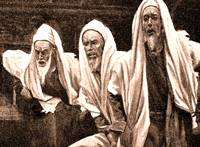
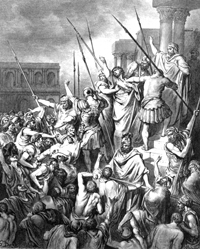 Saved from the blood-thirsty Jews. As if. Saved from the blood-thirsty Jews. As if.
Episode 2 – The Sanhedrin fails to kill Paul?
Bizarrely, the one vital snippet of information that Paul withholds at his first encounter with the "chief captain" of the Romans ("I am a citizen of Tarsus, a city of Cilicia") is his Roman citizenship. Only the later threat of a thrashing elicits this tidbit. Though the commander is now "afraid," Paul remains in custody.
The next day our hero is stood before the Jewish council, the Sanhedrin, though the charges against him remain opaque. Could a junior officer really order the Sanhedrin to meet? Once again, an echo of that irregular meeting of the council that tried Jesus.
No trial actually occurs. Apparently, by insulting the High Priest and claiming to be a Pharisee, Paul causes uproar in the Jewish council. Paul is struck on the mouth (as Jesus was struck in the mouth, John 18.22). "You whitewashed wall," says Paul (Acts 23.3), regurgitating the "You whitewashed tombs," put into the mouth of Jesus (Matthew 23.27)
The Pharisaic scribes, like Pilate at the trial of Jesus, "find no evil in this man." The meeting dissolves in disorder and, oddly, the Roman commander fears that council members will "pull the apostle into pieces." Paul is again taken into "protective custody."
This sets the scene for the next incredible installment.
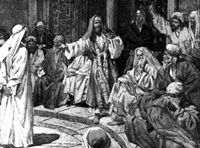 Inciting the Jewish Council to lynch law. As if. Inciting the Jewish Council to lynch law. As if.
Episode 3 – Sworn fanatics fail to kill Paul?
It seems that even within the mighty fortress, defended by a cohort of Roman soldiers, our hero is still not safe from the scheming of dastardly Jews. Hiss. Above forty raging fanatics "bind themselves
under a great curse" not to eat or drink until they have killed the
apostle.
How do we know this? Well, “it just so happens” that at this juncture Paul has a nephew in the city! What, all this has been happening and his sister has not once come to see him?!
It also just so happens that this young fellow "overhears" of the plot to kill his uncle – an incredible lapse of security on the part of the would-be assassins!
Incredibly, this nephew gains immediate access to “uncle Paul” in his fortress cell and reveals the plot to him. Incredibly, a centurion complies with Paul's instruction to escort the youth to the commander. Incredibly, the commander believes implicitly all that he hears from the boy and calls out the greater part of the garrison to provide an imperial guard for his Jewish trouble-maker (or has he already metamorphosed into a Christian grandee?). Incredibly, they are despatched that very night on a forced march halfway across the province. Dream on.
As a final touch in this other-worldly fantasy, "Luke" even reproduces the letter purportedly written by the commander in Jerusalem and delivered to Felix the governor in Caesarea!
"Claudius Lysias, to his Excellency the governor Felix, greetings. This man was seized by the Jews and was about to be killed by them when I came upon them with the soldiers and rescued him, having learned that he was a Roman citizen. And desiring to know the charge for which they were accusing him, I brought him down to their council. I found that he was being accused about questions of their law, but charged with nothing deserving death or imprisonment. And when it was disclosed to me that there would be a plot against the man, I sent him to you at once, ordering his accusers also to state before you what they have against him." – Acts 23.26-30.
Perhaps the commander's secretary was a secret Christian and had taken a file copy?
In fact, the words of "Claudius Lysias" are merely an echo of words used previously by Luke, placed in the mouth of Pontius Pilate at the trial of Jesus:
"Then Pilate called together the chief priests, the rulers, and the people [i.e. the Jews], and said to them, “You brought me this man as one who was misleading the people. When I examined him before you [the council], I did not find this man guilty of anything you accused him of doing. Neither did Herod, for he sent him back to us. Look, he has done nothing deserving death. I will therefore have him flogged and release him.”
– Luke 23:13-16.
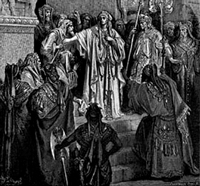 Too busy plotting to watch the door? Too busy plotting to watch the door?
An Unbelievable Yarn - 2
The Stephen and Paul Speech
In Acts 7 the protomartyr "Stephen" is brought before the Jewish council, the Sanhedrin, and is accused of blasphemy. In his address, the angel-faced Stephen recounts the sacred history of the Jews from Abraham, through Moses, to Solomon and finishes by using the words of the prophets to denounce "the Jews".
In Acts 13 "Paul", supposedly sermonizing in a synagogue in Pisidia, complements Stephen's story by adding the conquest of Canaan, the period of Judges, the preparation of John, and the coming of Jesus. He, too, finishes with a warning from the prophets.
An original text has been cut and pasted into two separate chapters of Acts of the Apostles, in both places where a "warning to the Jews" was required.
And where did it come from?
"The speech of Stephen is closely modelled on the 'Deuteronomic' psalms."
– G. Lampe, Peake's Commentary on the Bible, p884.
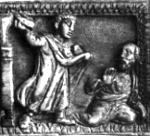
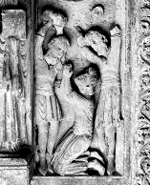
Both Stephen and Paul are Greek-speaking Jews, and both are stoned for their trouble.
However Paul, unlike the less fortunate Stephen, is required to keep the story running so he makes an instant recovery, despite being "dumped for dead" at Lystra.
Stephen's Speech to the Sanhedrin (Acts 7.2-53)
"Brothers and fathers, listen to me!
The God of glory appeared to our father Abraham while he was still in Mesopotamia, before he lived in Haran.
'Leave your country and your people,' God said, 'and go to the land I will show you.'
So he left the land of the Chaldeans and settled in Haran. After the death of his father, God sent him to this land where you are now living. He gave him no inheritance here, not even a foot of ground. But God promised him that he and his descendants after him would possess the land, even though at that time Abraham had no child.
God spoke to him in this way: 'Your descendants will be strangers in a country not their own, and they will be enslaved and mistreated four hundred years. But I will punish the nation they serve as slaves,' God said, 'and afterward they will come out of that country and worship me in this place.'
Then he gave Abraham the covenant of circumcision. And Abraham became the father of Isaac and circumcised him eight days after his birth. Later Isaac became the father of Jacob, and Jacob became the father of the twelve patriarchs. Because the patriarchs were jealous of Joseph, they sold him as a slave into Egypt. But God was with him and rescued him from all his troubles. He gave Joseph wisdom and enabled him to gain the goodwill of Pharaoh king of Egypt; so he made him ruler over Egypt and all his palace.
Then a famine struck all Egypt and Canaan, bringing great suffering, and our fathers could not find food. When Jacob heard that there was grain in Egypt, he sent our fathers on their first visit. On their second visit, Joseph told his brothers who he was, and Pharaoh learned about Joseph's family. After this, Joseph sent for his father Jacob and his whole family, seventy-five in all. Then Jacob went down to Egypt, where he and our fathers died. Their bodies were brought back to Shechem and placed in the tomb that Abraham had bought from the sons of Hamor at Shechem for a certain sum of money.
As the time drew near for God to fulfil his promise to Abraham, the number of our people in Egypt greatly increased. Then another king, who knew nothing about Joseph, became ruler of Egypt. He dealt treacherously with our people and oppressed our forefathers by forcing them to throw out their newborn babies so that they would die.
At that time Moses was born, and he was no ordinary child. For three months he was cared for in his father's house. When he was placed outside, Pharaoh's daughter took him and brought him up as her own son. Moses was educated in all the wisdom of the Egyptians and was powerful in speech and action.
When Moses was forty years old, he decided to visit his fellow Israelites. He saw one of them being mistreated by an Egyptian, so he went to his defense and avenged him by killing the Egyptian. Moses thought that his own people would realize that God was using him to rescue them, but they did not. The next day Moses came upon two Israelites who were fighting. He tried to reconcile them by saying, 'Men, you are brothers; why do you want to hurt each other?'
But the man who was mistreating the other pushed Moses aside and said, 'Who made you ruler and judge over us? Do you want to kill me as you killed the Egyptian yesterday?' When Moses heard this, he fled to Midian, where he settled as a foreigner and had two sons.
After forty years had passed, an angel appeared to Moses in the flames of a burning bush in the desert near Mount Sinai. When he saw this, he was amazed at the sight. As he went over to look more closely, he heard the Lord's voice: 'I am the God of your fathers, the God of Abraham, Isaac and Jacob.' Moses trembled with fear and did not dare to look.
Then the Lord said to him, 'Take off your sandals; the place where you are standing is holy ground. I have indeed seen the oppression of my people in Egypt. I have heard their groaning and have come down to set them free. Now come, I will send you back to Egypt.'
This is the same Moses whom they had rejected with the words, 'Who made you ruler and judge?' He was sent to be their ruler and deliverer by God himself, through the angel who appeared to him in the bush. He led them out of Egypt and did wonders and miraculous signs in Egypt, at the Red Sea and for forty years in the desert.
This is that Moses who told the Israelites, 'God will send you a prophet like me from your own people.' He was in the assembly in the desert, with the angel who spoke to him on Mount Sinai, and with our fathers; and he received living words to pass on to us.
But our fathers refused to obey him. Instead, they rejected him and in their hearts turned back to Egypt. They told Aaron, 'Make us gods who will go before us. As for this fellow Moses who led us out of Egypt — we don't know what has happened to him!' That was the time they made an idol in the form of a calf. They brought sacrifices to it and held a celebration in honor of what their hands had made. But God turned away and gave them over to the worship of the heavenly bodies.
This agrees with what is written in the book of the prophets:
'Did you bring me sacrifices and offerings
Forty years in the desert, O house of Israel?
You have lifted up the shrine of Molech
and the star of your god Rephan,
the idols you made to worship.
Therefore I will send you into exile' beyond Babylon.
Our forefathers had the tabernacle of the Testimony with them in the desert. It had been made as God directed Moses, according to the pattern he had seen. Having received the tabernacle, our fathers under Joshua brought it with them when they took the land from the nations God drove out before them. It remained in the land until the time of David, who enjoyed God's favor and asked that he might provide a dwelling place for the God of Jacob. But it was Solomon who built the house for him.
However, the Most High does not live in houses made by men. As the prophet says:
'Heaven is my throne,
and the earth is my footstool.
What kind of house will you build for me? says the Lord.
Or where will my resting place be?
Has not my hand made all these things?'
You stiff-necked people, with uncircumcised hearts and ears!
You are just like your fathers: You always resist the Holy Spirit! Was there ever a prophet your fathers did not persecute? They even killed those who predicted the coming of the Righteous One. And now you have betrayed and murdered him — you who have received the law that was put into effect through angels but have not obeyed it."
Paul continues the same story (Acts 13.16-41)
“Men of Israel, and you who fear God, listen:
The God of this people Israel chose our fathers, and exalted the people when they dwelt as strangers in the land of Egypt, and with an uplifted arm He brought them out of it. Now for a time of about forty years He put up with their ways in the wilderness. And when He had destroyed seven nations in the land of Canaan, He distributed their land to them by allotment.
After that He gave them judges for about four hundred and fifty years, until Samuel the prophet. And afterward they asked for a king; so God gave them Saul the son of Kish, a man of the tribe of Benjamin, for forty years. And when He had removed him, He raised up for them David as king, to whom also He gave testimony and said, ‘I have found David the son of Jesse, a man after My own heart, who will do all My will.’
From this man’s seed, according to the promise, God raised up for Israel a Savior — Jesus — after John had first preached, before His coming, the baptism of repentance to all the people of Israel.
And as John was finishing his course, he said, ‘Who do you think I am? I am not He. But behold, there comes One after me, the sandals of whose feet I am not worthy to loose.’
Men and brethren, sons of the family of Abraham, and those among you who fear God, to you the word of this salvation has been sent. For those who dwell in Jerusalem, and their rulers, because they did not know Him, nor even the voices of the Prophets which are read every Sabbath, have fulfilled them in condemning Him.
And though they found no cause for death in Him, they asked Pilate that He should be put to death. Now when they had fulfilled all that was written concerning Him, they took Him down from the tree and laid Him in a tomb.
But God raised Him from the dead. He was seen for many days by those who came up with Him from Galilee to Jerusalem, who are His witnesses to the people. And we declare to you glad tidings — that promise which was made to the fathers. God has fulfilled this for us their children, in that He has raised up Jesus. As it is also written in the second Psalm:
‘You are My Son,
Today I have begotten You.
And that He raised Him from the dead, no more to return to corruption,
He has spoken thus:
‘I will give you the sure mercies of David.’
Therefore He also says in another Psalm:
‘You will not allow Your Holy One to see corruption.’
For David, after he had served his own generation by the will of God, fell asleep, was buried with his fathers, and saw corruption; but He whom God raised up saw no corruption.
Therefore let it be known to you, brethren, that through this Man is preached to you the forgiveness of sins; and by Him everyone who believes is justified from all things from which you could not be justified by the law of Moses.
Beware therefore, lest what has been spoken in the prophets come upon you:
‘Behold, you despisers,
Marvel and perish!
For I work a work in your days,
A work which you will by no means believe,
Though one were to declare it to you.’
|
|
 |

|
|
Some fifty articles are now available as a book.
For your copy order:

|
|
'Save'
a friend e-mail this page
Copyright © 2010
by Kenneth Humphreys.
Copying is freely permitted, provided credit is given to the author and no
material herein is sold for profit.
|