Miniscule – The
'Carolingian Renaissance'
contribution to civilization
In
the ruins of the western empire the formal script
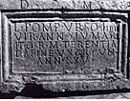
of the Romans – square capitals – was
to be found on imperial buildings everywhere. But
the Latin literary, or book hand, had disappeared.
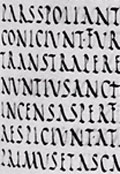
Use of the old un-spaced capital script – 'uncial' – though
attempted, made for ponderous communication.
When,
at the end of the 8th century, the warlord Charlemagne
established his impoverished 'empire', he ruled
a vast, disparate realm, populated by the descendants
of many races – Franks, Romans, Goths, Lombards,
Burgundians, Saxons etc. – who spoke several
different tongues.
So
barbarized had western Europe become that Christian
doctrine itself was fragmenting. In a number of
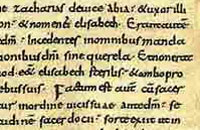
scattered monasteries, several 'national' styles
of Latin cursive had emerged – Italian, Merovingian,
Visigothic, Germanic, and Anglo-Irish. Each was
a 'monastery dialect' – an idiosyncratic
attempt to ease the laborious process of copying
manuscripts, a labour in which 'illumination' – pretty
pictures and calligraphy – took precedence. Even
the graphic art forms are not original but were
a throw back to a prehistoric art of the pre-Christian
era.
Copying
without comprehension centuries-old literature,
adding a little animal here, a fanciful capital
letter there, became the highest achievement of
this degenerate age. The
supposed sacred texts of the Bible now existed
in myriad local variations. Most clerics were illiterate
anyway, and
access to scripture was forbidden to the lay-person. Within
gem-overlaid covers and smothered by a riot of
calligraphy, lay the cold corpse of a language.
Charlemagne,
favoured son of the papacy, was committed to imposing
Roman Catholicism wherever his influence could
reach. He feared 'heresy' could emanate not only
from the mouths of pagans (who would either convert
or be killed) but also from ignorant priests who
could not read their own scriptures.
" For
when in the years just passed letters were often
written to us from several monasteries ... we
have recognized in most of these letters both
correct thoughts and uncouth expressions ...
Whence it happened that we began to fear lest
perchance, as the skill in writing was less,
so also the wisdom for understanding the Holy
Scriptures might be much less than it rightly
ought to be ... "
–
Charlemagne, letter
to Baugulf, abbot of
Fulda.
A
series of decrees or 'capitulars' were
issued which threatened clerics with loss of office
if they failed to acquire an ability to read and
write. Bishops supposedly had to ascertain compliance,
though they might themselves have been illiterate.
Charlemagne set out to impose a standardised Vulgate Bible,
a standardised Benedictine Rule and a standardised
liturgy but to achieve this he needed a standardised written language. The warlord found his man in Alcuin, a refugee from war-ravaged England, and
severely orthodox churchman.
Alcuin
and his monks (in the first 'cathedral school')
poured through all the classical works of antiquity
they could find for the inspiration for a new script.
"I,
your Flaccus, according to your exhortation
and encouragement ... am eager to inebriate
others with the old wine of ancient learning
..."
– Alcuin
of York, letter to Charlemagne
As
a result, Carolingian
minuscule developed, a familiar
combination of capital and small letters with most of the decorative flourishes and ligatures eliminated.
As
monastic agents expanded their activity – for
example, into England in the 10th century and into
Spain in the 11th century, Carolingian minuscule
became the written language of oppression
and religious orthodoxy.
It became the official script and literary
hand of the Frankish Empire. From it emerged all
the later 'Gothic', 'Roman' and 'Humanist' scripts,
still in use today.
|