Story Time
"In the time of Tertullian and Clemens of Alexandria [late 2nd - early 3rd centuries] the glory of martyrdom was confined to St Peter, St Paul and St James.
It was gradually bestowed on the rest of the apostles by the more recent Greeks, who prudently selected for the theatre of their preaching and sufferings some remote country beyond the limits of the Roman empire."
– Gibbon (Decline & Fall, 15)
Fantasy Factory
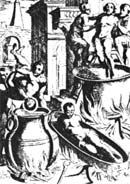
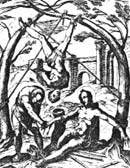
"The monks of succeeding ages, who in their peaceful solitudes, entertained themselves with diversifying the deaths and suffering of the primitive martyrs, have frequently invented torments of a much more refined and ingenious nature."
– Gibbon (Decline & Fall, 15)
A Fate Worse Than Death
"It is related that pious females, who were prepared to despise death, were sometimes condemned to a more severe trial, and called upon to determine whether they set a higher value on their religion or their chastity ...
The seasonal interposition of some miraculous power preserved the chaste spouses of Christ from the dishonour even of an involuntary defeat."
– Gibbon (Decline & Fall, 15)
Boob Job
St. Agatha
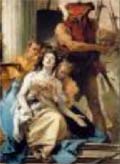
Agatha, a wealthy virgin of Sicily, had vowed her chastity to Christ. But Quintinian, a dastardly Roman consul, had designs on her virtue.Thwarted, he had Agatha put in a brothel run by 'Aphrodisia'. But still she managed to preserve her virginity.
A furious Quintinian had Agatha racked, scourged and her breasts cut off. These were miraculously restored by a vision of St Peter.
The determined consul had Agatha rolled naked in live coals mixed with broken potsherds.
Agatha died in prison. She was also burned at the stake. And also, when she failed to ignite, beheaded.
Gosh, talk about sex and violence.
What Would Jesus Do?
"Jerome, in his legend of Paul the Hermit, tells a strange story of a young man who was chained naked on a bed of flowers, and assaulted by a beautiful and wanton courtesan.
He quelled the rising temptation by biting off his tongue."
– Gibbon (Decline & Fall, 15)
Mind of a Fanatic
St Ignatius?
Just a tad TOO concerned with the mechanics of his own death?
"Let the fire, the gallows, the wild beasts, the breaking of bones, the pulling asunder of members, the bruising of my whole body, and the torments of the devil and hell itself come upon me, so that I may win Christ Jesus."
– Foxe's Book of Martyrs, 1968
Ignatius supposedly wrote this lurid drivel to Polycarp while on his way to martyrdom at Rome in 115.
HOW tall?
"It seems to be universally held that the Clementines are based upon the doctrines of the Book of Elchasai or Helxai, which was much used by the Ebionites.
The contents of it were said to have been revealed by an angel ninety-six miles high to a holy man Elchasai in the year 100 ..."
– The Catholic Encyclopedia, IV.
Lion Food?
No claim that Christians had been "thrown to wild beasts in the Colosseum" was made until 17th century – until the amphitheatre was being pillaged for building material to rebuild St Peters!
How and Why the Apostles were Fabricated
(off site)
by Frank Zindler
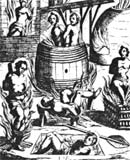
The vile tableaus of sadistic versatility would be grimly amusing were it not for the fact that, having convinced themselves that their pioneers had thus suffered, the Christians really did inflict such cruel barbarism on their opponents.
PS: A female apostle?
"Salute Andronicus and Junia, my kinsmen, and my fellow-prisoners, who are of note among the apostles, who also were in Christ before me." – Romans 16.7.
Early sources, including papyrus P46 circa 200, record the female form "Junia". But later sources add an accent on the final syllable to produce a more acceptable, if rather rare, male "Junias"!
Disciples couldn't perform
"When they came to the crowd, a man approached Jesus and knelt before him. 'Lord, have mercy on my son,' he said. 'He has seizures and is suffering greatly. He often falls into the fire or into the water.
I brought him to your disciples, but they could not heal him.'
'O unbelieving and perverse generation,' Jesus replied, 'how long shall I stay with you? How long shall I put up with you?
Bring the boy here to me.' Jesus rebuked the demon, and it came out of the boy, and he was healed from that moment.
Then the disciples came to Jesus in private and asked, 'Why couldn't we drive it out?'
He replied, 'Because you have so little faith. I tell you the truth, if you have faith as small as a mustard seed, you can say to this mountain, 'Move from here to there' and it will move. Nothing will be impossible for you.' "
– Matthew 17.14-20.
Well if it only takes faith as small as a mustard seed why don't we see Christians performing miracles?

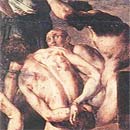
The apostles should be twelve of the most famous people in history. We're told they were hand picked by Jesus to witness his wondrous deeds, learn his sublime teachings, and take the good news of his kingdom to the ends of the earth. Which makes it all the more surprising that we know next to nothing about them. We can't even be sure of their names: the gospels list a collection of more than twenty names for the so-called twelve disciples – with Bartholomew sometimes showing up as Nathanael, Matthew as Levi and Jude as Thaddeus, Lebbaeus, or Daddaeus! It should be apparent that if the twelve were actual historical figures, with such an important role in the foundation and growth of the Church, it would be impossible to have such wild confusion over the basic question of who they really were. But what do we know about any of them?
"Twelve Good Men and True"? The fact is that for seven of the twelve, our only early source, the Gospels, say nothing about them at all. They are just names on a list. Isn't it a tad odd that such worthies, infused with the Holy Spirit and given powers to heal the sick and cast out demons, wrote nothing, or had nothing written for them or about them? Isn't it odd that men chosen to be eye-witnesses to the mighty deeds of Jesus, wrote no eye-witness statements, left no sermons, no memoirs, no letters, no teachings, no pithy words of encouragement? All that we have about "the twelve" are conflicting legends and fantastic stories from a much later date, tall stories about where they went, what they did and most especially how they died. Their deaths, it seems, have been recorded in loving and lurid detail. And it is the graphic deaths of the disciples that solves the riddle. We've all heard the apologetic claim: "Would they have died for a lie? Therefore the story of Jesus must be true." But we all know how useful to a cause is a dead martyr, even if he's a fiction. In the case of Jesus, the twelve are a fiction, a necessary entourage for a sun god, passing through the twelve constellations of the zodiac. Just like other saviour gods, Jesus had to have his retinue. The truth is, the twelve disciples are a grubby and sordid invention.
Martyrs to the Cause: Those "Suffering Disciples" "Would the disciples have suffered and died for a fabricated saviour?"
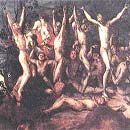
Though cruelty and human suffering have ever been integral to the history of the Church the fanatics of Christ have rarely been the victimized innocents. Rather it has been the Christians who have bathed their faith in the blood of others. There is NO corroborating evidence for the existence of the twelve Apostles and absolutely NO evidence for the colourful variety of martyrs' deaths they supposedly experienced. The Bible itself actually mentions the death of only two apostles, a James who was put to death by Herod Agrippa (see James for a discussion of this tricky character) and the nasty Judas Iscariot (see below), who gets several deaths because he's the bad guy. Legend and tradition alone, dreamed up by the early churches in their bid for legitimacy and authority, provided the uplifting fables of heroics and martyrdom. The plethora of conflicting claims and alternative deaths stand eloquent testimony to wholesale fabrication of the non-existent godman's non-existent companions.
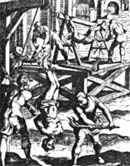
The Fabricated Deaths of the Apostles 1. Peter (aka Simon, Cephas). "Beheaded by Nero?" No, not really. This legend was dreamed up by the mid-2nd century pope Anicetus (156-166) when he became locked in a conflict with the venerable Polycarp of Smyrna. Polycarp had tried to win the argument (over the dating of Easter) by insisting that he spoke with the authority of the apostle John. In response, Anicetus staked a claim to Peter, and Peter, "Prince of the Apostles", trumps John. 2nd century texts known as the "Clementines" had made Peter the "first Bishop of Rome" and 3rd century invention gave him a 25-year pontificate – which made it a tad tricky for him to have died at the hands of Nero but, hey, this is "tradition." 3rd century Church Father Origen dreamed up a colourful flourish: Peter, feeling himself unworthy to be crucified the same way as his Lord, chose option 'B' – crucifixion upside down!
2. James, son of Zebedee (James the Greater?)
3. John, son of Zebedee. This guy has to be kept alive long enough to take care of Mary, lead the church in Ephesus, write the Book of Revelation and write his own gospel. He even survives being boiled in oil and is given a natural death! Actually, John bar Zebedee disappears from the yarn in Acts at the same time his brother James is more dramatically removed from the story. The last reference to John is also verse 12.2. From Acts 12.12 onward we are dealing with another John "whose surname was Mark" – a lightweight character who nonetheless is credited with authorship of the first gospel. The impending demotion of the thunder brothers is actually prefigured in Mark's gospel (and is embellished in Matthew, where Mrs Zebedee does the talking). The boys ask for front seats in the hereafter. JC is having none of it:
4. Andrew, brother of Peter. Pious invention gives Andrew a wonderful career covering everywhere from Scythia to Greece, from Asia Minor to Thrace. This guy, it seems, took option 'C' on the crucifixion menu: on an x-shaped cross. Apparently this allowed him to continue preaching for 2 days.
5. Philip. Fable places this guy in Phrygia, Carthage and Asia Minor. The fairy tale has a proconsul crucifying him for converting his wife. Perhaps the love feast got a bit out of hand. Somewhat confusingly, there are actually two Philips. The original apostle disappears from the tale after witnessing Jesus rise to Heaven from the Mount of Olives. Philip and the rest of the gang return to the upper room in Acts 1.13. But in Acts 6.5 a second Philip is chosen as one of the seven given responsibility for feeding widows
6. Bartholomew (Nathanael) What a traveller – India, Persia, Armenia, Ethiopia and southern Arabia! Miraculously he managed to get himself crucified (flayed alive and beheaded!) in both India and Armenia. Pretty impressive stuff. Even when dead his bits got about: a church in Rome claimed most of his corpse but 11th century Canterbury did a roaring trade with his arm! His emblem is the flaying knife. Cool.
7. Matthew (Levi son of Alphaeus) This guy has to be kept alive long enough to write his gospel – at least 20 years after the supposed death of Christ. Credited with 15 years in Jerusalem, then missions to Persia and Ethiopia and, of course, martyrdom in both places. According to Medieval iconography he worn spectacles, the better to count his tax money. If Matthew, aka Levi, is a son of Alphaeus (Mark 2.14) then presumably he is also the brother of James son of Alphaeus (Mark 3.18)? And yet we are told the lesser James is a son of Mary, sister of the Blessed Virgin and wife of Cleophas (John 19.25). In which case, the evangelist Matthew is a cousin of Jesus himself! However, Acts 1.13 tells us that the lesser James has a brother called Judas (aka Jude) whereas Mark (15.40) and Matthew's "own gospel" (27.56) both say that James has a brother named Joses. So we now have a regular band of brothers: James, Joses, Judas – plus Matthew/Levi ... which comes mightily close to the supposed four brothers of Jesus himself!
8. Thomas Didymus (the Twin) aka Judas Thomas or Jude Thomas Another grand traveller, seen everywhere from Parthia to Kerala in south India. 4th century invention, appropriately enough, gives this 'twin' two martyrdoms, one in Persia and one in India. He even gets a burial in Syria to boot! Yet another resting place, Mylapore, was claimed by the Portuguese in 16th century. Most famous for his "doubt", Thomas inspired a whole raft of pious flimflam: the Acts of Thomas (he built a palace for an Indian king, would you believe), the Apocalypse of Thomas, the Gospel of Thomas, and the Infant Gospel of Thomas. Now, have you still got any doubts ...?
9. James son of Alphaeus (James the Less – or is James the Just?) The myth-makers really go to town for this guy. Thrown down over 100 feet from the pinnacle of the Temple by "scribes and Pharisees", he actually survived only to be stoned, have his brains dashed out with a fuller’s club and have his body "sawn asunder" – all this at the age of 90! Of course, if we don't conflate James the Less with James the brother of Jesus (an identification made by Jerome and later Catholics) all this mayhem belongs with the righteous James and the fate of the lesser James is unknown. Perhaps it's the being sawn in half which causes the confusion?
10. Jude/Thaddeus /Lebbaeus /Daddaeus Either a serious clubbing or crucifixion for this mixed up guy in the city of Edessa or Persia. Apparently his fan-club suffered because his name sounded too much like Judas. Jude the apostle is often conflated with Jude the brother of Jesus and also with Jude the writer of the epistle of Jude (pay attention, there will be a test). Yet Jude (the letter writer) identifies himself as the brother of James and as a servant of Jesus, not his brother (Jude 1.1). He also speaks of the apostles in the past tense, not as if he was one of them (verse 17), so he cannot be identified as one of "the twelve" either.
11. Simon the Canaanite/ the Zealot. Invention came late for this guy. When it did, it was a beauty – crucifixion in Persia and also crucifixion thousands of miles away in Britain. He also managed to preach in Africa. Quite an act to follow.
12. Matthias. Fantasy sends this guy to Syria, Cappadocia, the shores of the Caspian and the "City of Cannibals" (Acts of Andrew and Matthias). Death by burning. Also death in Jerusalem by stoning – and beheading. Really just makes up the numbers, sometimes merging with Matthew and sometimes swapped out to let Paul into "the twelve."
13. Judas, son (or is that brother?) of James. Nothing yet. Feeling inspired?
14. Levi, son of Alphæus. Refer to his alter ego Matthew.
Mark (John Mark). Though neither Clement of Alexandria (?153-215), nor Origen of Alexandria (182-251) seem to have noticed, Eusebius of Caesarea (c.263-339) relays the news that the apostle Mark had been "first bishop" of Alexandria and had suffered martyrdom in the "eighth year of Nero." This would have been 61 AD – rendering the apostle dead before the death of Peter whose memoirs Mark supposedly wrote up as the Gospel of Mark. "Dragged to death", or maybe not. His bones – well, someone's bones – turned up in 9th century Venice.
Luke. "Hanged on an olive tree." Or, "lived to the age of 84 and died unmarried." Body parts claimed by both Padua and Constantinople.
Paul. "Beheaded by Nero." No, not really, but legend tells us he shared the same fate as Peter, even dying on the same day. Pious romances scribbled between the 2nd and 4th centuries – Acts of Paul, the Apocalypse of Paul, the Martyrdom of Paul and the Acts of Paul and Thecla – provide all the fabulous nonsense you could ever wish for.
Judas Iscariot.
The multiple deaths of Judas Iscariot – If the Jewish authorities, with their own agents, really had wanted to arrest a Jesus, supposedly a guru drawing vast crowds, they certainly would not have needed to hire an inside informer to identify the charismatic leader. Nor is it creditable that 'big money' would have been paid for (of all things) a kiss of the doomed messiah (Mark 14.44). The theological symbolism is as apparent as the history is bogus. The mythic "Judas" was a Gentile/Hellenistic creation of the early 2nd century, an eponymous focus for the anti-Judaism and anti-Semitism of the early Church. "Iscariot" appears to have been taken from the name of a rebel group called Sicarii, Jewish assassins who used sicae (small daggers), who were largely exterminated shortly before the first Jewish war. Ignatius, writing his epistles about 115, made no mention of a Judas Iscariot, but then, nor did he mention any 'disciples' (Paul and Peter are called 'apostles', that is, missionaries – like himself). But with a theologically necessary betrayal by 'a Jew/the Jews' the divine saviour passes, body and soul, into the possession of the Gentiles. In their disposal of Judas, the hapless traitor of the Lord – how could he help it, he had been entered by Satan?! (Luke 22.3) – the Christian scribblers get quite carried away. Papias in the 130s got the ball rolling.
The 12 become the 7 – sort of In Acts of the Apostles the eleven disciples, ordered by the risen Jesus to wait in Jerusalem for power from the Holy Spirit, drew lots to replace the hapless Judas Iscariot. They chose Matthias over Barsabas Justus and thus restored the magic circle. The wording used by Acts is curious: " one must be ordained to be a witness with us of his resurrection." At this stage "twelve" still has a divine or mystical importance. But after a Peter-led interlude (sermonizing at Pentecost, first miracles, arrest and re-arrest, etc.) "the Twelve" have outlived their usefulness. The cover story is that the apostles do not wish to "serve tables" (no kidding, Acts 6.2) or minister to "Grecian widows" – they want to get on with prayer and ministry. They direct that seven men, full of the Holy Ghost, be appointed to the more mundane business of welfare. What undermines the "authenticity" of this story is that from this point on the original (Jewish) disciples, now free to minister, almost disappear from the story. Instead, it is the "Hellenist" new guys, supposedly appointed for welfare work, who steal the limelight. Primacy goes to Stephen, who gives one big speech and becomes the first martyr, followed by Philip (not to be confused with the disciple of the same name) who works wonders in Samaria in competition with Simon Magus. Philip also converts the treasurer of Ethiopia and even "vanishes" from Gaza to reappear twenty five miles away in Azotus (Ashdod), courtesy of the Holy Spirit (Acts 8.39)! He obviously did not spend much time waiting on tables. Twenty-odd years later Philip is in Caesarea, where, as the father of four virgin soothsayers, he hosts the apostle Paul. The other Hellenists – Prochorus, Nicanor, Timon, Parmenas and Nicolas – are never mentioned again. Like most of the named apostles, they merely make up the number. By this stage Acts has become wholly preoccupied with a yarn about the adventures of Paul. As for the original witnesses chosen by Jesus – "fishers of men" divinely ordained to take the good news "to the uttermost ends of the earth" – they have faded into oblivion.
Church of the Shadows After the "deaths" of the Apostles, even Church historians offer no great missionary figures (they make a weak attempt with Ignatius). The gap of more than two centuries is filled with an anonymous church of the shadows. Retrospectively, the void was filled with "suffering Christians" – a fallacy, invented by a triumphant Church for its own greater glory, elaborated at length by the feverish minds of medieval churchmen and perpetuated in our own time by the studios of Hollywood.
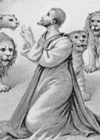
Propagandists would concoct a fanciful story in which the ‘blood of the martyrs became the seed of the church’; they would tell of a continuous progress, first in secret then openly, by which brave, pious, humble, and noble followers of Christ, faced up both raging lions and sadistic emperors. By their submission to suffering with a divinely inspired countenance, these pioneers of Christianity – apparently – won first the respect and then the heart of a dark and cruel pagan world.
Who Persecuted Whom? Across three centuries, a handful of Christian "martyrs" can be cited from a few locations. Their number, far from substantiating any general or sustained persecution of the early Christians, is no more than we would expect of a fraternity that, by the time of Constantine's coup, amounted to some tens of thousands and was drawn disproportionately from criminal and marginal classes. The general persecution of Christians occurred only when the Christian Empire turned its ferocity upon the heretics. The Roman Empire had lasted more than a thousand years and persecuted Christians for fewer than twelve of them. The 'Christian Empire' also lasted more than a thousand years and persecuted non-Christians through all of them.
Persecution – Holy Mother Church Invents Heroic OriginsSources:
Through near field communication you can easily share the information provided here with others. A mobile marketing agency can provide you with the knowledge needed so that you can spread your ideas to a vast audience in one speedy click of your phone. Don't worry mobile marketing tips are easy to comprehend and in a matter of seconds you will be proficient at it. |
||||||||||||||||||||||||||||||||||||||||||||||||||||||||||||||||||||||||||||



|
||||||||||||||||||||||||||||||||||||||||||



 |
|
|
|
|


Enlighten a friend e-mail this page
Copyright © 2005
by Kenneth Humphreys.
Copying is freely permitted, provided credit is given to the author and no
material herein is sold for profit.